
Media OS had features.What it didn't have was a plan.So we built the missing middle.
The gap between audience and activation was obvious. The path to filling it was anything but.
Context & Challenge
Media OS is a powerful platform — built to consolidate audience planning, campaign activation, and real-time measurement for pharma brands, agencies, and publishers. But between knowing your audience and launching a campaign, there was nothing. No way to forecast. No way to compare scenarios. No place inside the platform to actually plan.
Users had already solved for it themselves: Excel spreadsheets, side-by-side browser tabs, ghost campaigns built just to surface performance estimates. Three distinct workarounds for one structural gap. The Audience Forecasting Builder was designed to make those workarounds unnecessary.
The Design Challenge
Design a net-new forecasting capability — the first product area built from scratch at IQVIA Digital in years — that gives media planners a native way to build, compare, and reason about audience forecasts before committing to an activation.
Audiences
Missing
Activation
MyRole&Approach
I was the Lead Product Designer on a newly formed pod — one PM, one PO, four engineers. No inherited IA. No prior user feedback. No legacy patterns to react to. The JTBD, the MVP scope, the four design tenets — all defined from the ground up.
Phase 1
Discovery
HotJar, VoC Survey, Focus Groups
Mid-Sprint
AI Sprint
Vision possibilities, momentum to move
Phase 2
Exploration
4 directions rejected → AI prototyping
Phase 3
Vision Work
Reset, iterate, define
Phase 4
MVP Build
4 tenets, active development
TheWork
Discovery
The problem was observable before the first wireframe. HotJar pulled it plainly — planners working their real plans in Excel, toggling browser tabs to compare options, spinning up ghost campaigns just to see numbers the platform wouldn't give them natively. What was supposed to be a planning platform had become a staging ground. The platform gap was structural, not surface-level.
Multiple personas, one shared friction: Pharma Brand Managers, Media Planners, RFP Team Members, and Client Service Managers all hit the same wall — no way to reason about audiences before committing to activation.
The current activation flow was the wrong model. Users needed a distinct planning mental model — not a re-skin of audience building.
The gap wasn't a feature request. It was a behavior pattern. Users had already invented workarounds, which meant the demand was proven before a concept existed.
AI Sprint
Midway through Discovery, the pod stepped out of Forecasting to dream. The internal Product Summit had opened an AI sprint track, and we spent a week imagining what this tool could become — not what it had to be at MVP. The first of two AI moments in this project.
The sprint did two things at once. It cast the dream — surfacing vision possibilities for what this product could be three releases from now. And it carried the momentum — giving leadership and the team permission to keep building. Not a refined north star. The energy to find one.
The dream stayed with us through Exploration. The second AI moment came later.
Exploration
Building off the sprint's success and the definitions we captured from it, we turned to the harder question — what this had to be at MVP.
Four directions were prototyped. None survived.
The Activation Clone felt familiar — and imposed the wrong mental model. The Full-Featured Vision gave planners everything, which meant they couldn't find anything. The RFP-Focused Flow solved a different job for a different user. The Incomplete Forecast modeled the numbers but not the confidence to act on them.
Every rejection sharpened the definition of what this tool was supposed to be.
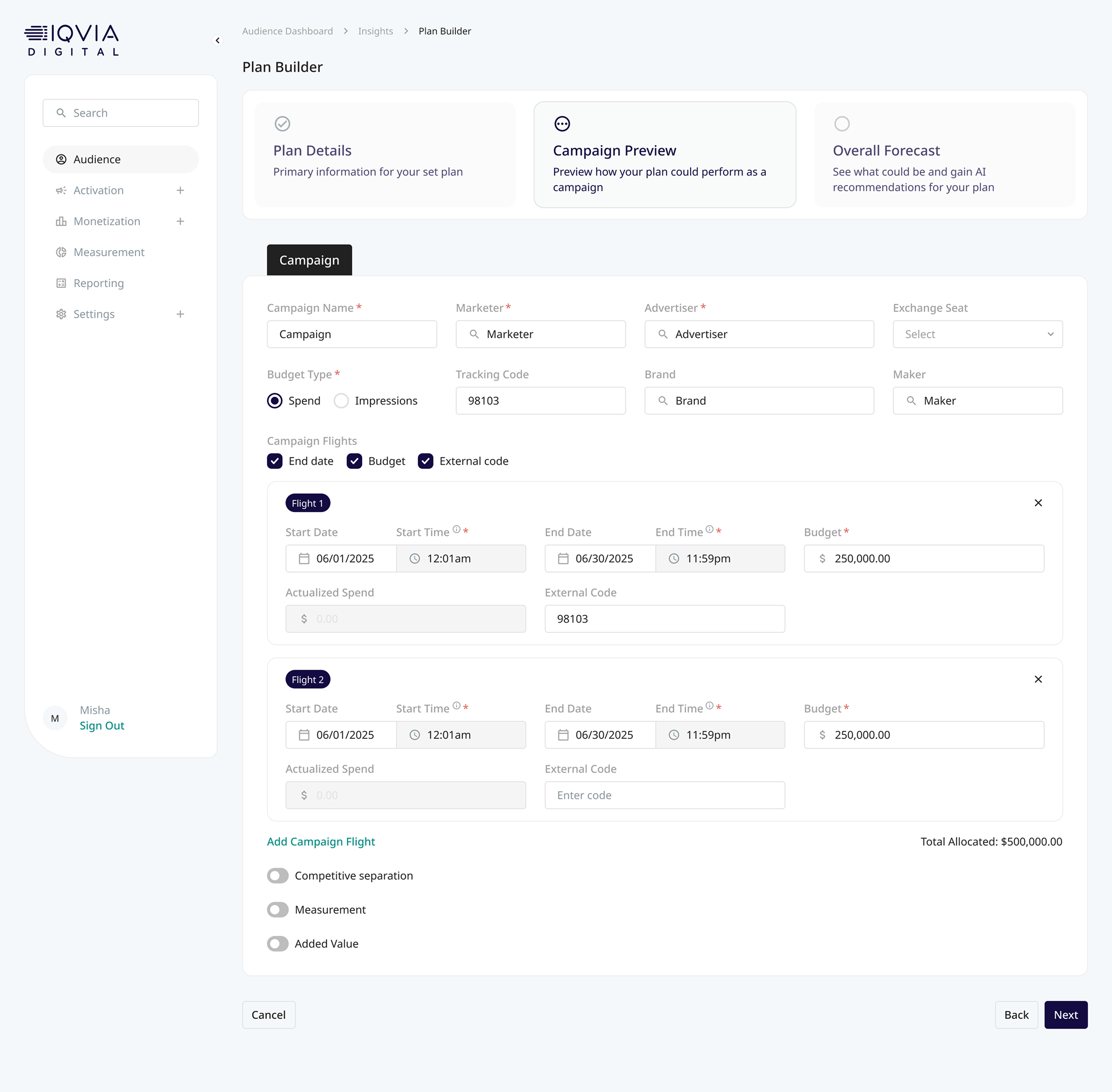
Activation Clone
01 / 03
Four directions, four rejections.
Then we stopped designing — and started imagining.

AI Ideation · Stitch
Late in Exploration, we let AI prototype the fifth direction.
The AI Sprint had cast the dream. The four rejections had narrowed the definition. Before decision time, we ran a generative ideation push using Stitch — Google's AI-native interface generator — testing what current AI prototyping tools could shape from our problem space.
Stitch shaped working flows fast. We learned where AI accelerates ideation — and just as importantly, where it papers over real design questions. The output scored well in internal previews. It surfaced recommendations, walked the user through every step, and looked like progress.
It was also doing too much for the user — and not enough with them.
“The answer came from understanding what every failed direction was protecting against.”
Key Design Decisions

Chosen
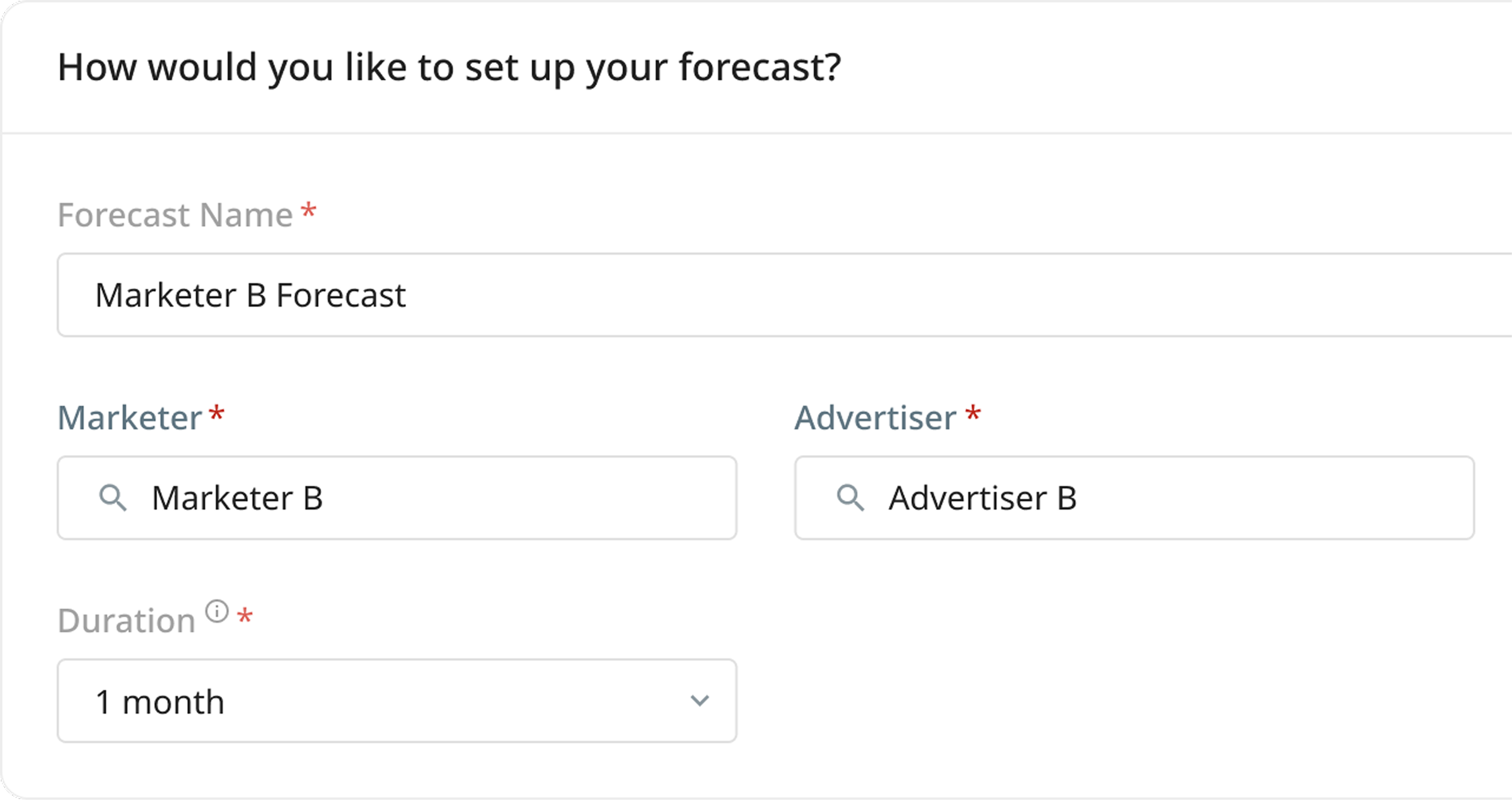
Anchor the MVP around the Pharma Brand Manager — the highest-frequency, highest-stakes user. Build a tool that fully serves their job, then expand.
Rejected
Full-scope planning tool serving Pharma Brand Managers, Media Planners, RFP Team Members, and Client Service Managers equally. Risk: diffuse focus, feature creep, longer time to first value.
The call: Narrowing to one primary persona wasn't about ignoring the others — it was the only way to define what 'done' looked like. The Pharma Brand Manager's job gave the MVP a clear success condition: can they build a forecast, compare scenarios, and make a channel recommendation, all without leaving the platform?
Chosen
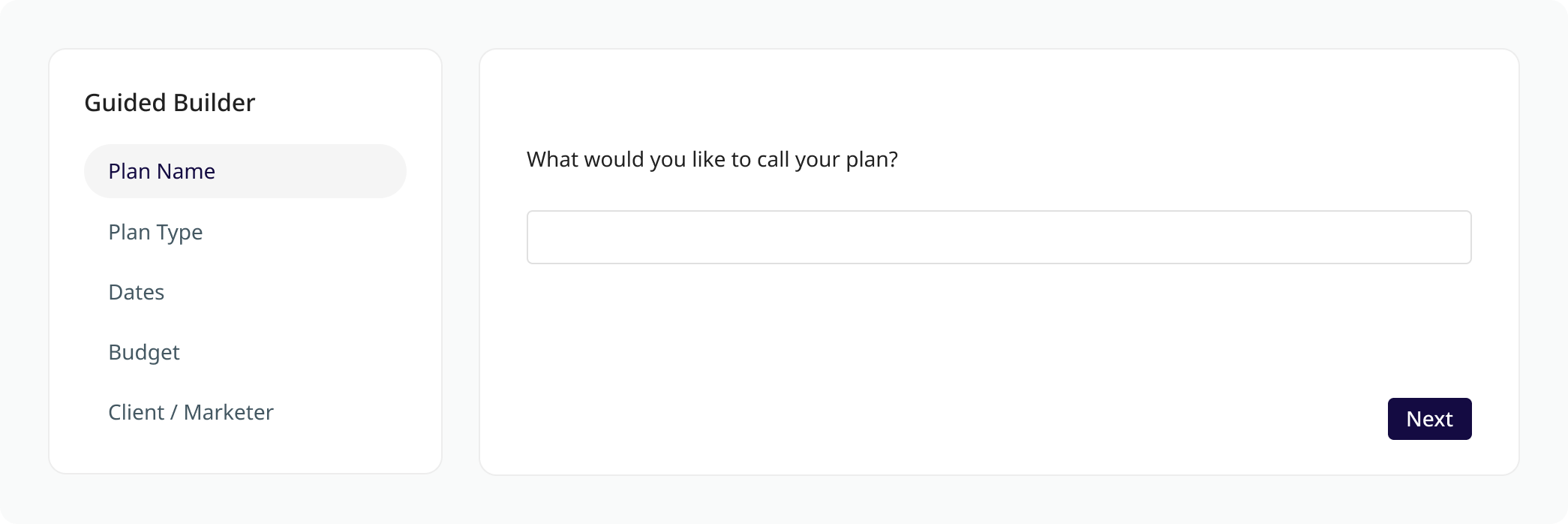
Progressive disclosure — surface the most important decisions first, keep advanced options accessible but not foregrounded. Designed for the first experience, not the hundredth.
Rejected
Expose every configuration option. Maximum flexibility for experienced planners. Risk: steep learning curve, slow first-run experience.
The call: Guided simplicity became one of four MVP tenets — alongside Clarity First, Efficient Task Completion, and Foundational Trust. The four tenets weren't aesthetic principles. They were filters: every design decision had to pass all four before it could stay.
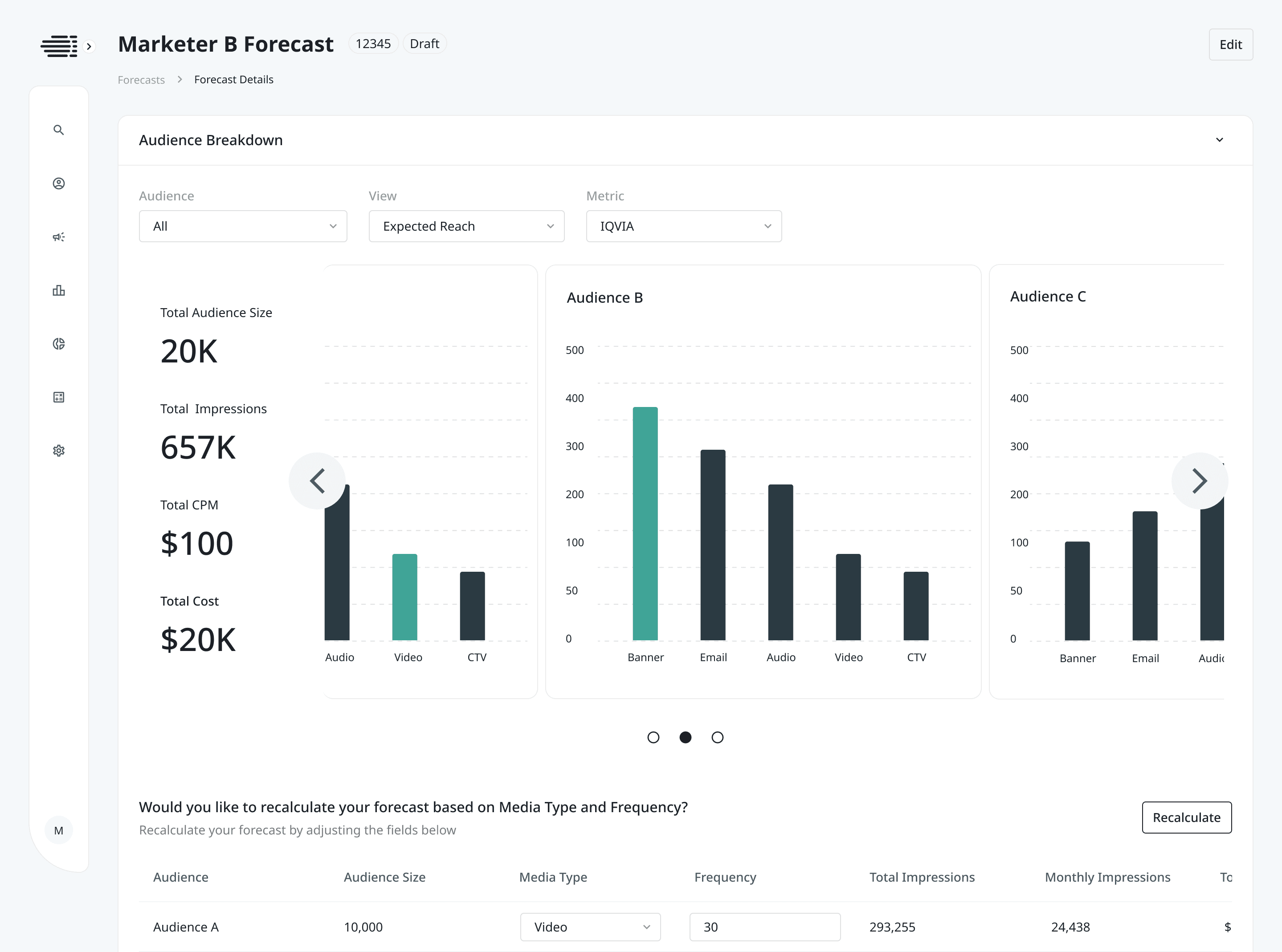
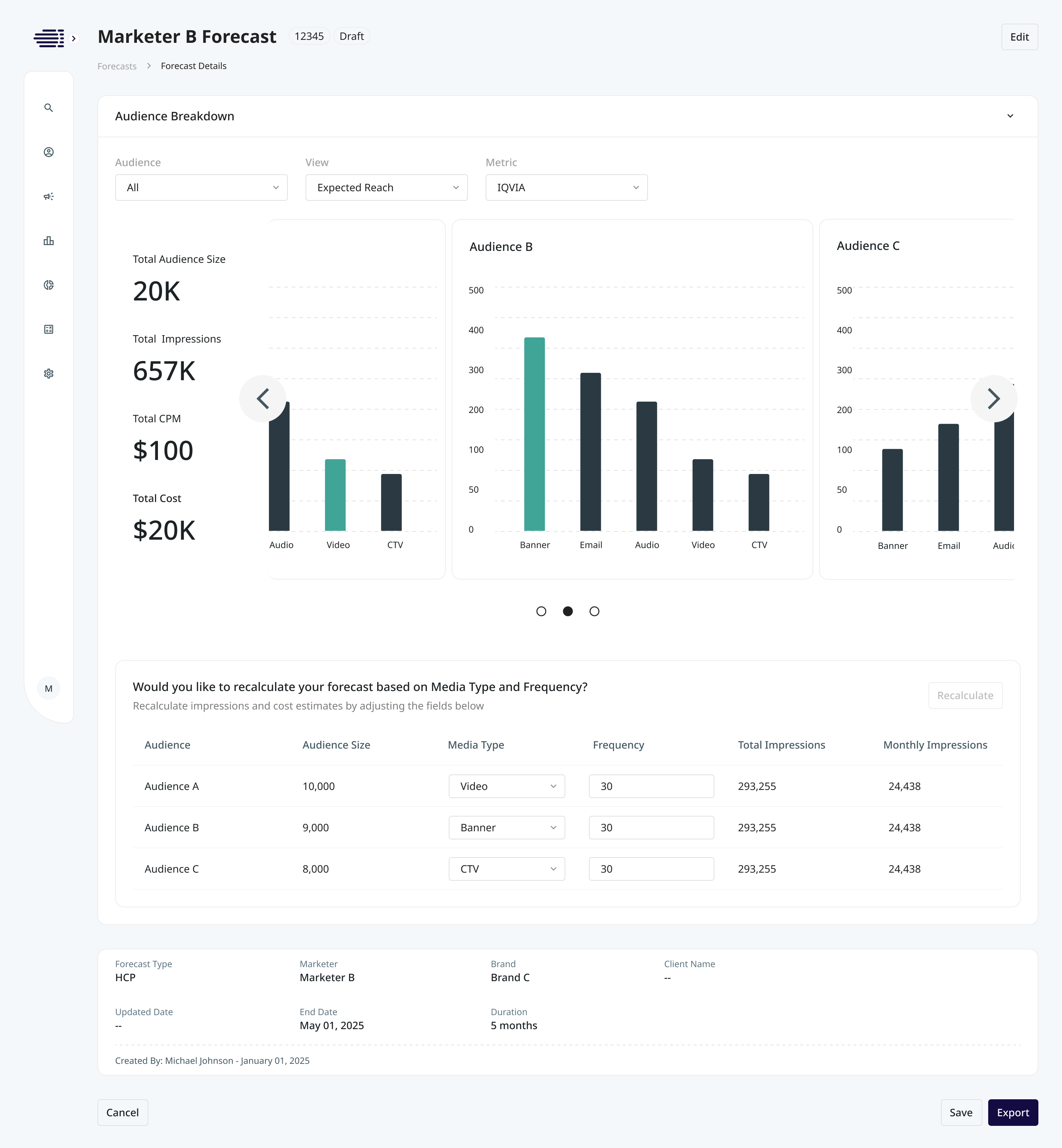
Total Audience Size
0K
Total Impressions
0K
Total CPM
$0
Total Cost
$0K
Chosen
Reset after the AI ideation phase. Keep the Stitch prototype as a research artifact — proof of what's possible — but design the MVP around user agency. Surface the information, let the planner make the call.
Rejected
Carry the Stitch prototype directly into the MVP. Faster to ship, closer to a vision that already looked polished. Risk: a tool that told planners what to do instead of helping them think.
The call: The MVP's job was different from the prototype's job. It needed to give planners a place to reason, not a system that reasoned for them.
Final Designs
Outcome&Impact
First new product area
The first module built from scratch at IQVIA Digital in years — 0-to-1, no prior design, no inherited patterns
MVP in active development
Super-admin release approaching after 3 months of design and build
3 workarounds retired
Excel forecasting, browser-tab comparison, and ghost campaign estimation — all replaced natively
The Audience Forecasting Builder quietly redrew what IQVIA Digital believes it can build from scratch.
Building net-new taught me what making-better couldn't: I belong where the problem is still open.
— Reflection